When you're conjuring up a world of your own, or if you've been in an environment, it is much easier and faster to write a scene. Often times, I write about places I've never been. I watch and listen to videos. I read about the location. I step into that world in my mind. These things take time. Add to that the time it takes to review the finished work and the time it takes to have the scientist review the work and I wonder how I can accomplish anything.
If all goes according to the plans, one story of mine will be published in mid-September under a Creative Commons License. I plan to extend the reach of that important material by having it reprinted, if possible. In October, my ChemMatters article will, hopefully, see the light of publication.
Downy or hairy woodpecker feathers?
Last week, I heard a series of loud, sharp bird cries that sounded like an alarm call. When I looked outside, I ran for the camera. This huge hawk was perched on the post. I opened the screen to get an unobscured photograph. When the cat stuck her head out the window, the raptor flew away. I found the feathers on the deck. While I was trying to figure out which bird left their polka-dotted parts, I discovered this nifty website to identify feathers.
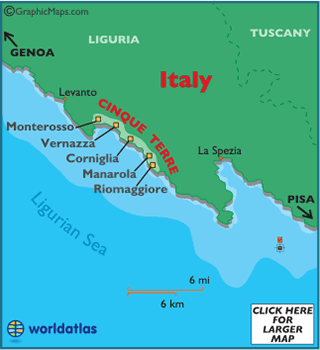
This is a hike I did while staying in Vernazza in the Cinque Terre in Italy. These five villages nestled on hills by the coast and connected by a rail line, have narrow cobbled streets and old world charm. The people were warm and pleasant.
This was an interesting way of remembering the dead.
We found a trail and followed it uphill, past elderly Italians gathering grapes and a memorial honoring the dead. It turned out to be the 508. Eventually, the trail led to a sanctuary with a chapel and a bench overlooking the ocean. Under the hot sun, we hiked midway across the mountain with stunning views of the coast. Butterflies flitted on tiny flowers in yellow, purple and pink. Finally we reached Sanctuary Savoie, which had a soft pink hue. We took the 509 down. It was one long, straight descent, a huge drop in elevation in a short amount of time.
What an anniversary celebration!
Narrow streets in the villages
When we arrived in Monterosso, we were hot, tired and starving, so we found a place to eat. In an absolutely amazing bit of timing, our friends from Connecticut pulled into town minutes earlier and they too were hungry. The folks at their hotel suggested the very same outdoor restaurant where we were seated. It was a glorious and memorable day running into them in a foreign country when neither of us knew each other's itinerary.
On the writing scene, it looks like I may have FINALLY finished edits to "Light in the Cellar of the Sea," an article that is slated for the October/November issue of ChemMatters. Yesterday, I submitted a blog post that will hopefully be published this summer. I'm also working on numerous other projects, including a highly creative collaborative project.
I believe I took this on the popular blue trail from Vernazza to Corniglia.
Lemon tree very pretty and the lemon flower is sweet...
I'm taking a step back in time and posting about another great, but challenging international hike. I wish I'd brought hiking poles for this one. We started our hike at Rifugio Auronzo, which is accessible by bus. It didn't take long to reach Rifugio Lavaredo, but our stop there was brief. As we trudged down a steep incline, I knew we'd eventually be going back uphill, and what an uphill it was. By the time we reached Rifugio Pian di Cengia, we were starving. I ordered a colorful dumpling platter with spinach-green, cheddar-yellow, and beet-red dumplings. They were fabulous.
Rifugio Pian di Cengi is a Tyrolean hut that serves Austrian food.
A sign outside Rifugio Pian di Cengi shows mountain flowers.
It was freezing cold when we left, but I was still in shorts. As we made our way to the next hut, snow flurries fell from the dark and cloudy sky. It was an easy hike to Rifugio Locatelli, which is nestled at the foothills of the Tre Cime rock formation, three immense boulders. By the time we got there, the flurries had become fat flakes, clinging to shoulders and boulders.
The Tre Cime towers over Rifugio Locatelli.
We spent the night in the dorm room, which was the only available lodging. At that point, it was too dark to keep hiking. I knew the pill vials on the chair next to my bunk were not a good sign. Sure enough, I got a bed next to Mr Virus-and-Bacteria. All night I heard his hacking. You'd think with a raspy, crackling cough that you might need extra sleep. Oh no, not this go-getter. He set his alarm clock unreasonably early. The following morning we hiked out and passed some really interesting World War I bunkers.
Miniature horses were grazing on the mountainside.
The beauty of this place is that you can access these mountains by hiking them or by taking numerous lifts to the top. Here in Connecticut, we hike to a view. In the Dolomites, there is a new vista around every curve and atop every hill. While I was there, I carried a Cicerone hiking guidebook (multi-day) in my pack. They are great books with short walks and long walks in many different locations.
World War I bunker
In other news, I've updated the "Writing" and "Awards and reviews" sections of this website with some reprinted clips and some recent happy news.
Winners: Edward Tucchio, Janet Croog, Kelly Hill, Jeanne Zulick
On May 13th, I was surprised and delighted to receive an email from the Shoreline Arts Alliance that my nonfiction picture book manuscript won a Tassy Walden Award! Last night, I drove to the Blackstone Memorial Library in Branford for the ceremony. Thankfully, I gave myself plenty of time because I wound up turning off the engine on the highway for about fifteen minutes while emergency personnel cleaned up an accident. Luckily, I was in the shade of a tractor-trailer because it was hot and humid and the air-conditioning in the Civic was weak, at best (my goal is 200,000 miles for this ole heap).
Middle grade and young adult honorable mentions and finalists
It was an enjoyable evening listening to other writers read their work and meeting new writing folks. Edward Tucchio, an artist who has painted murals at the Peabody museum, read his illustrated picture book. Janet Croog, the illustration winner, had a diverse portfolio that included amazing paper cutouts (one had a finished size of over five feet!). One recipient has already a landed a contract with Random House.
I found out there are anywhere between 200–400 submissions to this contest. Half the entrants submit picture book texts. The picture book category is the only one that accepts nonfiction and they get about five entries each time. The contest is judged by anonymous agents and editors. Given those statistics, I feel very fortunate and pleased and privileged that my nonfiction manuscript rose to the top of a good-sized pile of predominantly fiction. I'm thankful for the Shoreline Arts Association and for the judges for their time and energy running and judging this contest.
This past weekend I attended the New England SCBWI conference in Springfield, Massachusetts. It was refreshing to be totally immersed in the writing world with few opportunities for my thoughts to wander. My writing friends and I volunteered on Friday. For lunch, we had fantastic German food at the Student Prince. I got home late, got up early the next day and groggily attended sessions on Saturday. I went to query and synopsis workshops where I learned I was doing some things wrong (ack!).
My friends don't like to be photographed, so I secretly photographed them from above--until they caught me.
Jo Knowles got a rock star reception when she entered the ballroom.
The keynoters were all good speakers. Jo Knowles' personal journey was captivating. Much of what she said hit home--the shy, quiet kid, the brother, the PEN award, and the controversial topics that need to get out there.
My happy plate
I got brave and signed up for open mic. I contemplated scratching my name off the list, but decided it was good practice reading in front of strangers. Others in the room felt the need to perform as they read. Personally, I thought the words should convey the story and that jumping around was a distraction. What I found surprising is that many of the participants wrote in rhyme. It was interesting hearing different styles and voices.
I responded to a misleading piece that insinuated that this winter's snow meant there was no warming.
This past month, I fired off a couple of letters after reading a misleading blurb in a regional newspaper. It took advantage of the general public's lack of understanding of the difference between climate and weather. Many other newspapers would never have published it. In tiny font, the newspaper wrote they didn't verify this section.
In my last post, that fox den that I thought was a pile of dirt was really a split boulder covered with snow.
That coyote den that I thought was a fallen tree was really a brush pile. Surprise, surprise.
Right now, I'm working on an assignment for a new client. I will let you know more details after my story is published later this summer. I am grateful to be busy the next couple of weeks.
The past couple of weeks I've been revising a ChemMatters article that was supposed to get published in October 2012. I like the new direction this article is taking. It's fascinating stuff.
This was one of two entrances. Fox den?
I will be volunteering at the New England SCBWI conference on Friday, April 24th and attending on Saturday. I also hope to attend some of the National Association of Science Writer's conference in Boston in October.
Tracks crisscrossing through the snow.
Several weeks ago, I was snowshoeing and noticed a whole bunch of tracks crisscrossing through an open field. This was off the trail, in an area where there were no human tracks. The variety of tracks made it an interesting place to explore. Adding to the excitement, one man that we talked with said he'd spotted a bobcat at this location.
Glove is 5.5" across and 8" long at widest points
I found two animal homes. The larger one had three entrances and looked like it might have been a snow-buried fallen log. A smaller burrow in the dirt had two entrances. I wish I had a flashlight to snoop in those holes. We've had rain recently, so I want to go back this week and see if I can find clearer prints in the fresh mud.
A hopping animal?
Monday, March 2, 2015
mourning dove
Last month, reality settled in my joints, slowing movements in all directions. I'm still a writer and a fighter, but I sustained a pretty hard blow. I'm somewhat dazed because half of me is searching for answers I'll never find. This month, I resolve to climb all the way back in the writing rink and return to regular exercise too. Wish me luck!
song sparrow
I neglected to mention, in January the Royal Society of Chemistry published my article on vultures. It was challenging to write that in one week because I don't consider myself a fast writer. The edits for that article arrived on January 13th, not a great time by any means. It was extraordinarily difficult to focus on revision, but I did my best because I was dealing with a new editor. After emailing my edits, I informed the editor of the situation.
mourning dove
I'm halfway through a six-week massive open online creativity course. I'm glad I signed up for this because it's serving two purposes. First, it's keeping me busy when I really need to be kept busy. Second, I'm trying to squeeze every ounce of creativity out of me.
I have always considered myself creative, but I'd like to strengthen that if I can. I've learned that creativity involves original ideas and divergent thinking. At the start of the class, I took a creativity assessment. I did pretty well on originality, but only mediocre on divergent thinking (the number and uniqueness of ideas). I also learned that my most original ideas aren't my first ideas. Since play stimulates creativity, I went sledding as a class assignment. Now that was a thrill!
This year has been a painful one. When I wake up in the morning or in the middle of the night, my thoughts echo like the clanging of a hollow pipe or a church
bell ringing in an empty village.Dan. Dan. Dan. Dan. Dan. Dan. I’m dedicating this post to my 24-year-old
son.
When Dan and his twin sister, Melanie, came into our
lives, we were joyous.Having them to
love was a gift.We felt lucky—really
lucky.Our luck turned to worry when he
was six months old and he needed surgery.He
spent a month in the hospital.We nearly
lost him then.
I can see Daniel waving goodbye.
When he finally came home, he smiled easily and
often.He was the kid that couldn’t
contain his excitement.When the room
was silent at a library presentation, he shouted, “OWL, OWL!”He picked out a rabbit puppet for his sister’s
3rd birthday.Before Melanie
received the gift, he hinted about it.It’s white…..and soft….. and fluffy……and it’s
a BUNNY!
Dan was always cheery and chatty, lively and
loving.He was a tester with a great
sense of humor.When I told him to get
his foot off the table, he’d watch my face intently. Then he'd place one toe right
back on the table.Once, when my sister
took the twins to a Rockcats game, a little girl asked Dan what his name
was.He replied, “Hotdog.”
In high school he needed major surgery, which was most
likely a consequence of the surgery he had endured as an infant.Dan forged onward, without looking back.He never complained.He never dwelled on the past.He never used it as an excuse.He was good-natured and kindhearted.At home he seldom swore or got angry and he was
always willing to help a friend.Before
he left for work, he'd tuck the dog beneath the covers of his bed.
When we got word that Dan was in the hospital, we
never lost hope because Dan was a survivor.Most of the time we were there, the sky was gray and the air, bitter
cold.One evening, I watched the sun set
from the empty room next door.It was a
silent reminder of the passing of another day.It was one of those simple things that we’d brushed aside to be by his
bed, day and night.Over and over again,
I said, “we’re not giving up on you.We’ll
be by your side to help you get through this.”
In his final hours at the hospital, sunshine
streamed beneath a partially-closed shade.The only light in the room shone on his face.The heavens were calling.With great sadness, we said goodbye to a life
of promise, a heart of kindness, a gift to treasure.Dan was the flower, late to bloom, the angel that
slipped away too soon.
When you’ve lost something so precious, it can’t be
replaced.The best you can do is to make
as much good out of it as you can.During surgery, Dan received bone from the bone bank.When he passed on, he gave it back.
Daniel is traveling tonight on a plane (In Alaska, the pilot took his hands off the wheel).
From Daniel, we learned to take what life hands us and
to move on with grace and resiliency.In
one sense, we feel cheated.In another
we feel lucky—lucky that we got to know him, lucky that we got to see him
blossom into the beautiful person that he was.We are honored to be his parents and proud of all his accomplishments.We will cherish our memories of a wonderful
son and brother.Dan, you will live on
forever in our hearts.
What a delight to receive all these enthusiastic thank you notes!
When a friend asked me to speak to her three eighth grade classes, I put a lot of thought into how best to present the material. My goal was to create a presentation with information that would sink in and stand the test of time. On December 8th, I spoke to all three classes at Timothy Edwards Middle School in South Windsor. The enthusiasm and the feedback I received were so positive that I really want to get this valuable program on writing, revision and research into more schools. I plan to put a flyer together after the holidays.
We hiked to that little building on top.
Look at that, you don't need to sweat or strain, the chairlift (left) is next to the hut.
In the morning, we lingered, not wanting to leave.
On September 11th, we hiked to Rifugio Lagazui (a hut) in Passo Falzarego in the Dolomites. Limestone chips and chunks slid beneath our feet as we hiked this steep, rocky, strenuous trail. As we got higher a cold, metal railing aided our steps on precipitous ledges. I was slow and careful hiking this baby, but it was
WWI tunnel
oh, so exciting.
There were remnants of WWI scattered in the towering spires. After trekking uphill for some time, we came to one--a tunnel! Limestone slurry trickled down steep steps as we gripped the icy railing and made are way up the mountain in darkness, aided only by headlamps. At a nearly 45 degree angle, the steps were exhausting. Every now and then we'd pass a window. We hiked in darkness for close to 45 minutes.
Near the top, we peered in a rocky room with bunk beds and leftover warfare. The tunnel was narrower, so we had to watch our heads (this might be a helmet recommended hike). The rifugio was perched on a cliff, so it had a magnificent view. At dinner we sat next to Ed and Sarah from San Francisco and Steve and Terry from Maine. It was great to be at a table of Americans for a change.
Yesterday, I received the December issue of Highlights for Children. My article about a scientist who trekked through the rainforest in Brazil to study beautiful golden lion tamarins, was published on page 16 and 17. That article was submitted in 2005 and I had given up ever seeing it in print. Needless to say, I was quite pleased. Time has improved the piece.
At yesterday's Appalachian Mountain Club Annual Gathering, my presentation was after one that included live birds, a tough act to follow. There were twenty-two people in the room, which was a smaller crowd than I expected. It was the first time I had ever stood in front of a room without my heart beating fast and furious. I was calm, and as a friend who was in the audience said, "I interjected humor." The only issue I had was that I was unable to connect to the internet and play two short videos. This did not surprise me. Thankfully, I had downloaded four sound clips to my laptop and was able to play those. Aside from the videos, the talk went really well.
When we got off the cable car, we strolled down wide trails through a rich green meadow.
Add caption
While we were in Italy, we spent two nights in Castelrotto (the Germans call it Kastelruth) in the Dolomites. It was not nearly enough time to explore the vast spring-green meadow high in the mountains. There were many ski lifts that allowed easy access to peaks that would wear out the strongest hiker. We got up to the top later than I would have liked. By then the gray clouds had rolled in. We walked in the gloomy rain and fog, down paths that smelled of hay, past cow bells tinkling and horses grazing on wet grass. The clouds had cleared when we arrived at a 200° panorama at a lookout called Engelrast. What a phenomenal view! As the sun sank lower in the sky, shadows on the jagged limestone peaks became more pronounced. Light on the mountains glowed on the pink coral of an ancient sea.
Add caption
The Dolomites are a hiker's paradise. The Alpe di Suisi is better suited for those who like walking on rolling hills versus the steeper inclines at Cortina D'Ampezzo.